
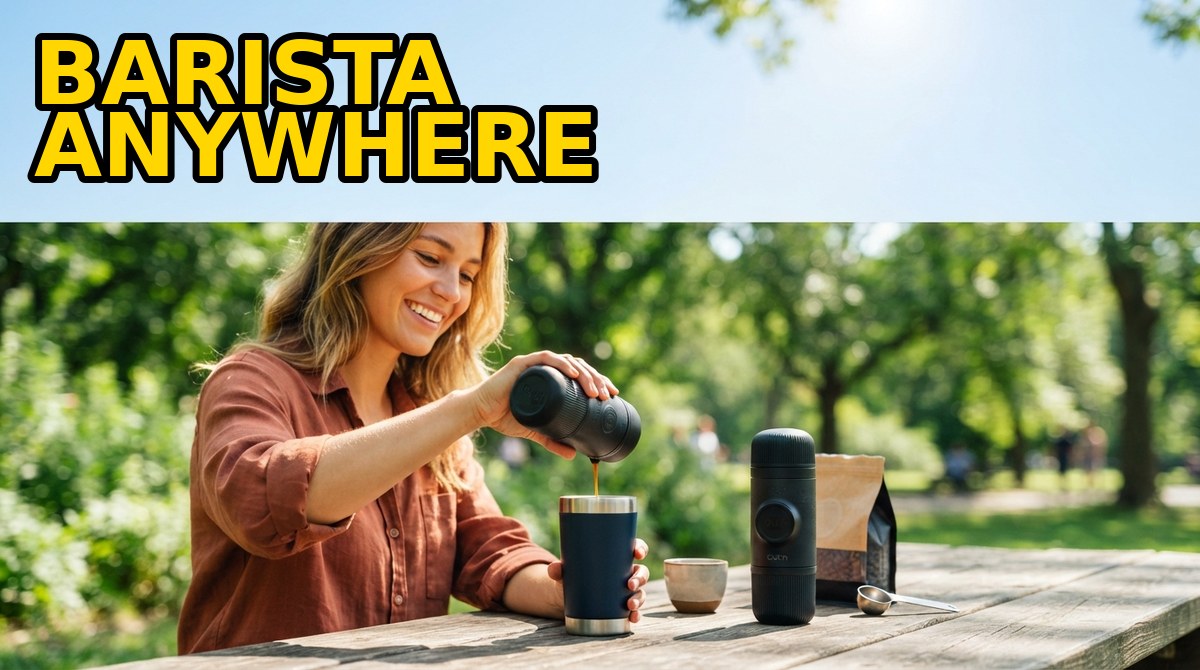
OutIn Portable Espresso Machine Review 2026: Real Barista Shots Anywhere You Go
We put the OutIn Nano and Mino portable electric espresso makers through a hands-on evaluation of pressure, heating speed, battery life and build quality — here is our honest verdict.
If your best coffee moments happen far from your kitchen — a sunrise at a trailhead, a long road trip, a hotel room with only a sad drip machine — the OutIn portable espresso machine is built for exactly that gap. OutIn makes battery-powered, self-heating espresso makers that pull a real pressurized shot without a wall outlet, a stovetop, or a bag of ice. In this review we look at the two machines that anchor the lineup: the OutIn Nano and the newer OutIn Mino. Everything below is drawn from OutIn’s published specifications and our hands-on evaluation of how the platform performs for travelers, campers and van-lifers.
☕ What Is the OutIn Portable Espresso Machine?
The OutIn Nano is a self-contained electric espresso maker roughly the size of a large water bottle. It carries its own rechargeable battery and a heating element, so you add room-temperature water and ground coffee (or a capsule), press one button, and it heats the water and drives it through the puck at pressure — no separate kettle, no hand-pumping, no external power required. The Mino is the pocket-sized sibling: slimmer, lighter, and rated for even higher pressure and faster heating. Both aim at the same goal — a genuine crema-topped shot anywhere — but they hit different points on the size-versus-power curve.
Unlike manual pump devices (which need you to pour in pre-boiled water and work a lever), OutIn machines are fully electric and self-heating. That is the core reason people choose them, and it is worth checking the current OutIn configurations and pricing before you decide which model fits your routine.
⚙️ Key Specifications
| Spec | OutIn Nano | OutIn Mino |
|---|---|---|
| Pressure | 20 bar | 22 bar |
| Heating | ~200s to ~92°C/198°F | 50ml to 199.9°F in ~149s |
| Battery | 2,500mAh, ~5 cold-water brews / 200+ hot-water | Quick charge 20–80% in ~45min |
| Weight / Size | 670g | φ67mm × 195mm, pocket-sized |
| Coffee format | Ground + capsules (2-in-1) | Ground coffee |
| Durability | Food-safe steel, BPA-free | IP67, altitude to 5,000m |
| Charging | 12V/24V car + USB (>10W) | USB fast charge |
| Starting price | $149.99 | $199.99 |
🔥 Brewing Performance & Crema
The headline number people fixate on is pressure, and here OutIn is generous: 20 bar on the Nano and 22 bar on the Mino, versus the ~9 bar a traditional machine actually uses at the puck. High rated pressure does not automatically mean a better shot, but it gives the pump enough headroom to push hot water through a fine puck and build a visible layer of crema — the thing that separates “espresso” from “strong coffee.” In practice, with a fine grind and a properly dosed basket, both machines produce a legitimate crema-topped shot.
Heating is the other half of the equation, and it is where OutIn’s self-heating design shines. The Nano brings room-temperature water up to roughly 92°C/198°F in about 200 seconds; the Mino is quoted even faster, hitting 199.9°F in around 149 seconds for a 50ml shot. That means you can start with tap or bottle water — no thermos of pre-boiled water to lug around. If you already have hot water, both skip the heating step and brew almost instantly, which is why the Nano’s battery stretches to 200+ brews on hot water versus about five when it does all the heating itself.
Ready to pull espresso off-grid?
📱 Design, Portability & Build
The Nano is the do-everything model: at 670g it is heavier and chunkier, but it is the one that accepts both ground coffee and capsules and charges off a 12V/24V car socket, which makes it the obvious pick for road trips and van life. The Mino trades that flexibility for pocketability — at φ67mm × 195mm it genuinely slips into a jacket pocket or the side sleeve of a daypack, and it adds IP67 splash-and-dust resistance plus stable extraction at altitudes up to 5,000m for hikers and mountaineers. Both use food-safe stainless steel and a BPA-free Tritan cup, so nothing sketchy touches your coffee.
One-button operation keeps the learning curve near zero. The main ritual you have to nail is grind and dose: OutIn recommends starting fine (grind level 2–1 with their Fino grinder) and adjusting to taste. Cleanup is a quick rinse of the basket and cup.
✅ Pros & Cons
👍 Pros
- Truly cordless — battery-powered and self-heating
- Real 20–22 bar pressure produces genuine crema
- Fast heat-up (~150–200s) from cold water
- Nano takes ground coffee and capsules
- Car (12V/24V) and USB charging
- Food-safe steel + BPA-free Tritan build; Mino adds IP67
👎 Cons
- Premium price ($149.99+) vs manual pump makers
- Cold-water brews per charge are limited (~5 on Nano)
- Single-shot capacity — not for serving a group
- Grind dialing-in still matters for a great shot
- Not usable in-flight; carry-on only per airline rules
💰 Pricing & Value
The Nano starts at $149.99 across its color options, while the Mino sits at $199.99 and gift sets (Nano Lotus, Mino Traveler) run up to $249.99. That is real money next to a $30 manual travel press, and it is fair to ask whether it is worth it. The answer depends on how you drink coffee away from home: if you want a push-button, no-kettle shot in a hotel, a campsite or a car, the self-heating electric design is the entire point and nothing cheaper replicates it. If you are happy boiling water separately and pumping by hand, you can spend far less.
OutIn frequently runs promotions (recent site banners advertised tiered discounts on orders over $149 and $249), so it is worth checking today’s OutIn pricing and any active bundle deals before buying — the effective price with a coupon can narrow the gap considerably.
🏕 Who Should Buy It (and Who Should Not)
The OutIn platform is aimed at a specific coffee drinker: someone who refuses to accept bad coffee just because they are away from a kitchen. If you are a road-tripper or van-lifer, the Nano is close to ideal — it charges straight from your 12V/24V socket, takes capsules when you cannot be bothered to grind, and lives in a cup holder. If you are a backpacker, hiker or overlander, the Mino’s pocket size, IP67 resistance and altitude-stable extraction are tailored to you: it is the model that survives being tossed in a pack and used at a windy 4,000m saddle. Hotel and office users benefit too — a self-heating shot beats lobby drip or a capsule machine you do not control.
Who should skip it? If you mostly drink coffee at home, a countertop machine will out-perform any portable at this price. If your budget is tight and you are content boiling water separately, a manual travel press or an AeroPress gets you 80% of the way for a fraction of the cost. And if you need to serve several people at once, the single-shot capacity will frustrate you — OutIn is a personal brewer, not a group solution. Being honest about your actual use pattern is the difference between a $150 device you love and one that lives in a drawer.
It also helps to think about the whole kit rather than the machine alone. OutIn sells protective cases (the EVA Plus, Nano case), extra filter baskets for double shots, travel tumblers and grinders. If you are going to rely on it daily, the case is worth budgeting for — it protects the heating chamber and battery from the knocks that come with travel, which is exactly the environment these machines are sold into.
🔬 How OutIn Compares to Other Portable Options
The portable-espresso category splits into three groups, and understanding them clarifies where OutIn sits. First are the manual pump makers (the classic hand-pump travel espresso makers): cheap, no battery, but you must supply pre-heated water and physically pump each shot. Second are AeroPress-style immersion brewers: excellent, affordable, extremely packable — but they make pressed coffee, not true crema espresso, and still need hot water. Third are self-heating electric machines like OutIn, which are the only group that removes both the kettle and the manual labor.
Within that third group, OutIn’s differentiators are the fast self-heating (~150–200s from cold), the dual ground-and-capsule compatibility on the Nano, car charging, and a build that is clearly engineered for abuse rather than a countertop. The trade-offs are consistent across all self-heating electrics: they cost more, they are heavier than a plastic press, and the battery does real work when it heats water, so cold-start shots per charge are limited. If a push-button hot shot with zero prep is what you want, OutIn is one of the strongest executions of the idea currently on the market.
Prices and bundles shift with OutIn’s promotions, so the smart move is to compare the Nano and Mino directly on the official OutIn store and factor in any active coupon before committing to a model.
🙋 Frequently Asked Questions
Does the OutIn make real espresso or just strong coffee?
It pulls a genuine pressurized shot — 20 bar on the Nano, 22 bar on the Mino — which, with a fine grind and proper dose, produces espresso with a crema layer, not just steeped coffee.
Do I need to bring hot water?
No. Both machines self-heat room-temperature water (the Nano in about 200 seconds, the Mino faster). If you do have hot water on hand, they brew almost instantly and the battery lasts far longer.
How many shots per charge?
On the Nano’s 2,500mAh battery, expect roughly five brews when it heats cold water itself, or 200+ brews if you supply hot water. Heating is what drains the battery.
Can I use capsules or only ground coffee?
The Nano is a 2-in-1 brewer that accepts both ground coffee and capsules. The Mino is designed around ground coffee. Choose based on your preferred format.
Can I take it on a plane?
Carry it in your carry-on luggage and do not operate it during the flight. Always follow current airline battery and device regulations.
🏆 Final Verdict
The OutIn portable espresso machine delivers on a genuinely hard promise: a real, crema-topped espresso shot with no outlet, no stovetop and no pre-boiled water. The Nano is the versatile all-rounder — ground coffee or capsules, car charging, best value at $149.99 — and is the model most people should start with. The Mino is the specialist for ultralight travelers and hikers who want pocket size, IP67 durability and high-altitude reliability. Neither is cheap, and the cold-water battery ceiling is a real limitation, but for anyone whose coffee ritual has to travel, OutIn is one of the few devices that actually pulls it off. Weighed on features, build quality and the sheer novelty of a proper crema shot in the middle of nowhere, it earns a confident recommendation for its intended audience.
★ CHECK THE LATEST OUTIN PRICESee colors, bundles and current deals →
Read next



Travel Hacks Guide Editorial Standards & Testing Methodology
At Travel Hacks Guide, we independently evaluate car rentals, international eSIMs, flight booking engines, and travel insurance. We never accept payment for ranking or recommendations. When you book via links on our site, we may earn an affiliate commission at no extra cost to you.